

Categories
- All blogs (32)
- Business Plan (5)
- Cities (31)
- Industry (10)
- Sap Business One (20)
- Technology (3)
SAP Business One vs Tally Prime: Which ERP is Better for Growing Businesses in India?
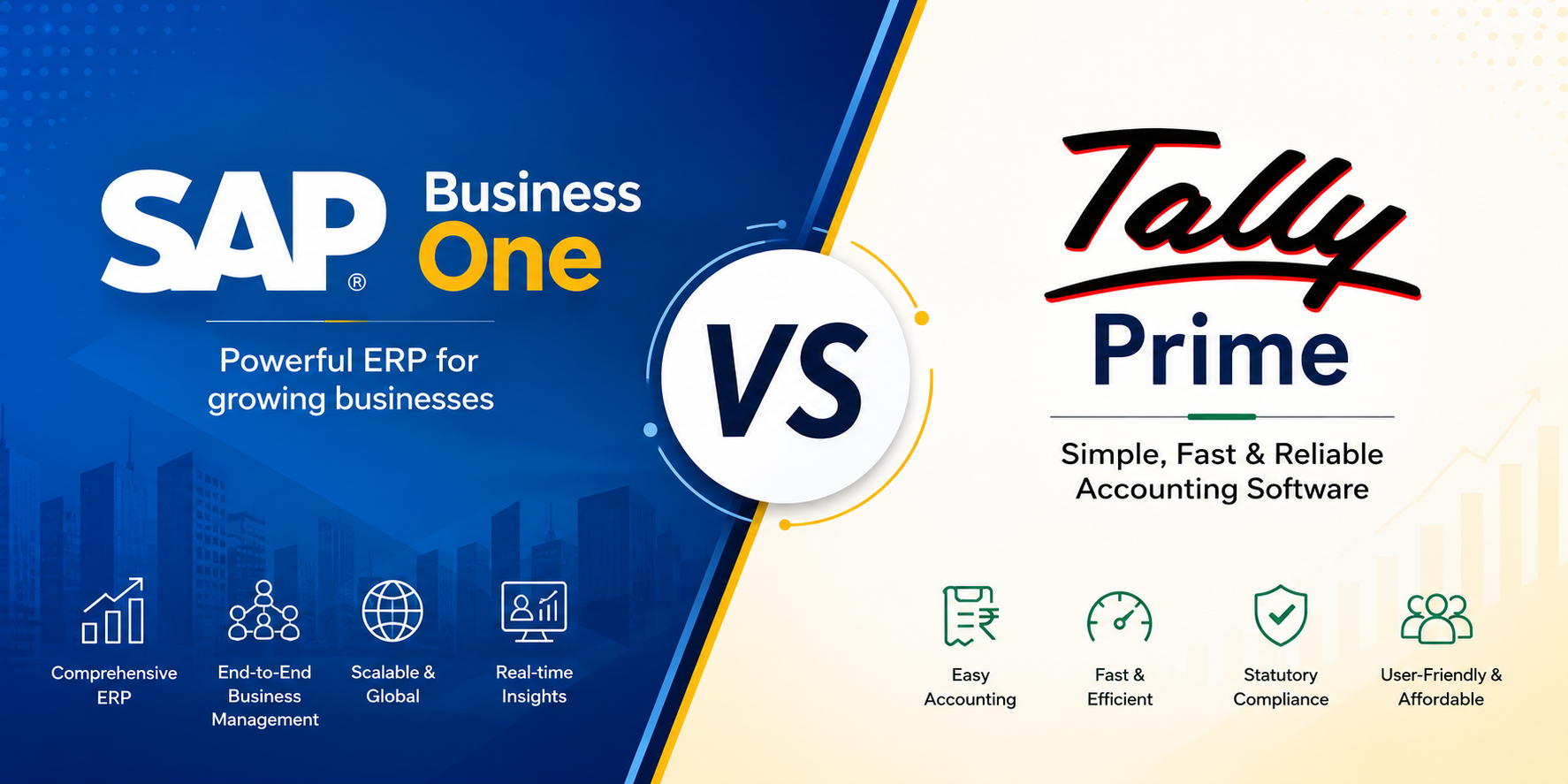
For many small and medium-sized businesses in India, TallyPrime is often the first software used to manage accounting and finance operations. It is simple, widely adopted, and works well during the early stages of business growth.
However, as companies expand their operations, open multiple branches, manage larger inventories, increase production activities, or handle complex workflows, they often begin facing operational challenges that basic accounting software cannot efficiently manage.
This is where businesses start evaluating enterprise resource planning (ERP) solutions such as SAP Business One.
The most common question business owners ask is:
“Should we continue with Tally Prime, or is it time to move to SAP Business One?”
In this blog, we will compare SAP Business One and Tally Prime across multiple business functions, helping Indian SMEs understand which solution is better suited for long-term growth, operational efficiency, and scalability.
Understanding Tally Prime
TallyPrime is one of India’s most widely used accounting and GST software solutions. It is popular among small businesses due to its ease of use, affordability, and strong accounting capabilities.
Tally Prime is commonly used for:
- Financial accounting
- GST compliance
- Basic inventory management
- Voucher entries
- Payroll
- Taxation
- Banking reconciliation
For businesses with relatively simple operations, Tally can work efficiently. However, operational complexity increases as businesses scale.
Many growing organizations eventually experience limitations in:
- Multi-location inventory visibility
- Production planning
- Workflow approvals
- Real-time reporting
- Automation
- CRM integration
- Business analytics
- Centralized operations
What is SAP Business One?
SAP Business One is a complete enterprise resource planning (ERP) solution designed specifically for small and mid-sized businesses.
Unlike accounting software, SAP Business One integrates all critical business functions into a single centralized platform.
SAP Business One helps businesses manage:
- Finance and accounting
- Inventory management
- Sales and CRM
- Purchasing
- Warehouse operations
- Production planning
- Quality control
- Service management
- Reporting and analytics
- Approvals and workflows
- Multi-branch operations
It provides real-time visibility across the organization, helping management make faster and more accurate business decisions.
SAP Business One vs Tally Prime: Feature Comparison
| Feature | Tally Prime | SAP Business One |
|---|---|---|
| Financial Accounting | Yes | Yes |
| GST Compliance | Yes | Yes |
| Inventory Management | Basic | Advanced |
| Multi-Warehouse Management | Limited | Advanced |
| Production Planning | Limited | Yes |
| MRP (Material Requirement Planning) | No | Yes |
| CRM | No | Yes |
| Approval Workflow | Basic | Advanced |
| Mobile Access | Limited | Yes |
| Dashboards & Analytics | Basic | Advanced |
| Batch & Serial Tracking | Limited | Advanced |
| Multi-Branch Management | Basic | Advanced |
| Role-Based Authorization | Limited | Advanced |
| Real-Time Reporting | Limited | Yes |
| Integration Capabilities | Limited | Extensive |
| Scalability | Medium | High |
When Tally Prime Starts Becoming a Challenge
Many Indian businesses begin with Tally because their operations are relatively simple. But as the organization grows, business processes become more interconnected and difficult to manage manually.
Below are some common operational challenges businesses face while using Tally for growing operations.
Excessive Dependency on Excel
One of the biggest signs that a company is outgrowing Tally is heavy dependency on Excel spreadsheets.
Businesses often use Excel for:
- Inventory tracking
- Production planning
- Approvals
- Sales reporting
- Dispatch planning
- Procurement monitoring
- Branch consolidation
This creates:
- Duplicate data entry
- Version mismatch
- Manual errors
- Reporting delays
- Lack of real-time visibility
Over time, operational inefficiencies increase significantly.
Difficulty Managing Multiple Branches
As businesses expand geographically, centralized visibility becomes critical.
Many companies struggle with:
- Stock transfer tracking
- Branch-wise profitability
- Centralized approvals
- Inventory visibility
- Consolidated reporting
Managing multiple branches manually or through disconnected systems often leads to delays and inaccuracies.
SAP Business One provides centralized control across branches, warehouses, and business units.
Limited Manufacturing & Production Capabilities
For manufacturing companies, production planning becomes difficult when operations grow.
Challenges often include:
- Raw material shortages
- Production delays
- Excess inventory
- Inaccurate BOM tracking
- Rejection management
- Poor production visibility
Tally is primarily accounting-focused and may require multiple manual processes to manage manufacturing workflows.
SAP Business One includes:
- Bill of Materials (BOM)
- MRP
- Production orders
- Batch tracking
- Quality management
- Shop floor visibility
This helps manufacturers improve operational efficiency and reduce wastage.
Lack of Real-Time Business Visibility
Business leaders today require instant access to:
- Sales performance
- Inventory valuation
- Outstanding payments
- Profitability
- Production status
- Procurement insights
In many growing businesses using Tally, generating consolidated reports can become time-consuming and manual.
SAP Business One offers real-time dashboards, analytics, and management reporting that help decision-makers act faster.
Manual Approval Processes
As organizations scale, approval workflows become essential.
Businesses commonly require approvals for:
- Purchase requests
- Payments
- Discounts
- Production activities
- Vendor onboarding
Manual approval systems increase operational delays and reduce accountability.
SAP Business One supports automated workflow approvals, improving process control and operational transparency.
Why Growing Businesses Move to SAP Business One
Businesses typically move from Tally to SAP Business One when they require:
- Operational automation
- Centralized visibility
- Business scalability
- Process standardization
- Real-time reporting
- Advanced inventory control
- Manufacturing management
- Stronger compliance and audit control
SAP Business One enables businesses to move from reactive operations to proactive business management.
Industries That Benefit from SAP Business One
SAP Business One is widely adopted across multiple industries in India.
Manufacturing Industry
Manufacturers use SAP Business One for:
- Production planning
- Inventory optimization
- MRP
- Batch traceability
- Quality management
Tyre & Automobile Industry
Tyre dealerships and automobile businesses benefit through:
- OEM credit management
- Multi-branch inventory tracking
- Spare parts management
- Dealer operations management
Food & Beverage Industry
Businesses can manage:
- Batch traceability
- Expiry tracking
- Recipe management
- Quality control
Pharmaceutical Industry
SAP Business One supports:
- Batch management
- Compliance tracking
- Expiry monitoring
- Regulated manufacturing processes
Distribution Businesses
Distributors benefit from:
- Warehouse management
- Faster dispatch planning
- Sales visibility
- Procurement optimization
SAP Business One vs Tally Prime: Pricing Perspective
Pricing is one of the most important considerations when businesses evaluate ERP solutions.
Tally Prime generally has lower initial software costs. However, businesses often overlook the hidden operational costs associated with:
- Manual work
- Multiple spreadsheets
- Disconnected systems
- Reporting delays
- Inventory inaccuracies
- Lack of automation
SAP Business One may involve higher initial investment, but it provides long-term operational efficiency, scalability, and business control.
For growing businesses, the return on investment often becomes visible through:
- Reduced operational errors
- Improved productivity
- Better inventory control
- Faster decision-making
- Process automation
Who Should Continue Using Tally Prime?
Tally Prime may still be suitable for businesses that:
- Have simple accounting requirements
- Operate from a single location
- Maintain limited inventory
- Do not require advanced workflows
- Have relatively small operational teams
For early-stage businesses, Tally can remain a practical solution.
Who Should Choose SAP Business One?
- Are rapidly growing
- Manage multiple branches or warehouses
- Operate manufacturing units
- Require real-time visibility
- Want process automation
- Need stronger inventory control
- Struggle with Excel-based operations
- Require scalable ERP infrastructure
SAP Business One is ideal for businesses that: Businesses planning long-term growth typically benefit significantly from ERP adoption.
Final Verdict
Both Tally Prime and SAP Business One serve important business needs, but they are designed for different stages of business maturity.
TallyPrime is highly effective for accounting-focused operations and smaller organizations with relatively simple workflows.
However, businesses aiming for operational scalability, automation, centralized visibility, and process optimization often find greater long-term value in SAP Business One.
The right decision depends on your:
- Business complexity
- Operational scale
- Growth plans
- Process requirements
- Reporting expectations
If your organization is increasingly dependent on Excel, facing inventory visibility challenges, or struggling with operational coordination, it may be the right time to evaluate an ERP platform like SAP Business One.
About Piculets Solutions
Piculets Solutions helps businesses implement and optimize SAP Business One across manufacturing, distribution, retail, automobile, tyre, and service industries.
Our team supports organizations with:
- SAP Business One implementation
- ERP consulting
- Customization
- SAP HANA migration
- Integration services
- Support and optimization
If your business is evaluating ERP solutions or planning to move beyond traditional accounting systems, our experts can help you assess the right ERP roadmap for your organization.
